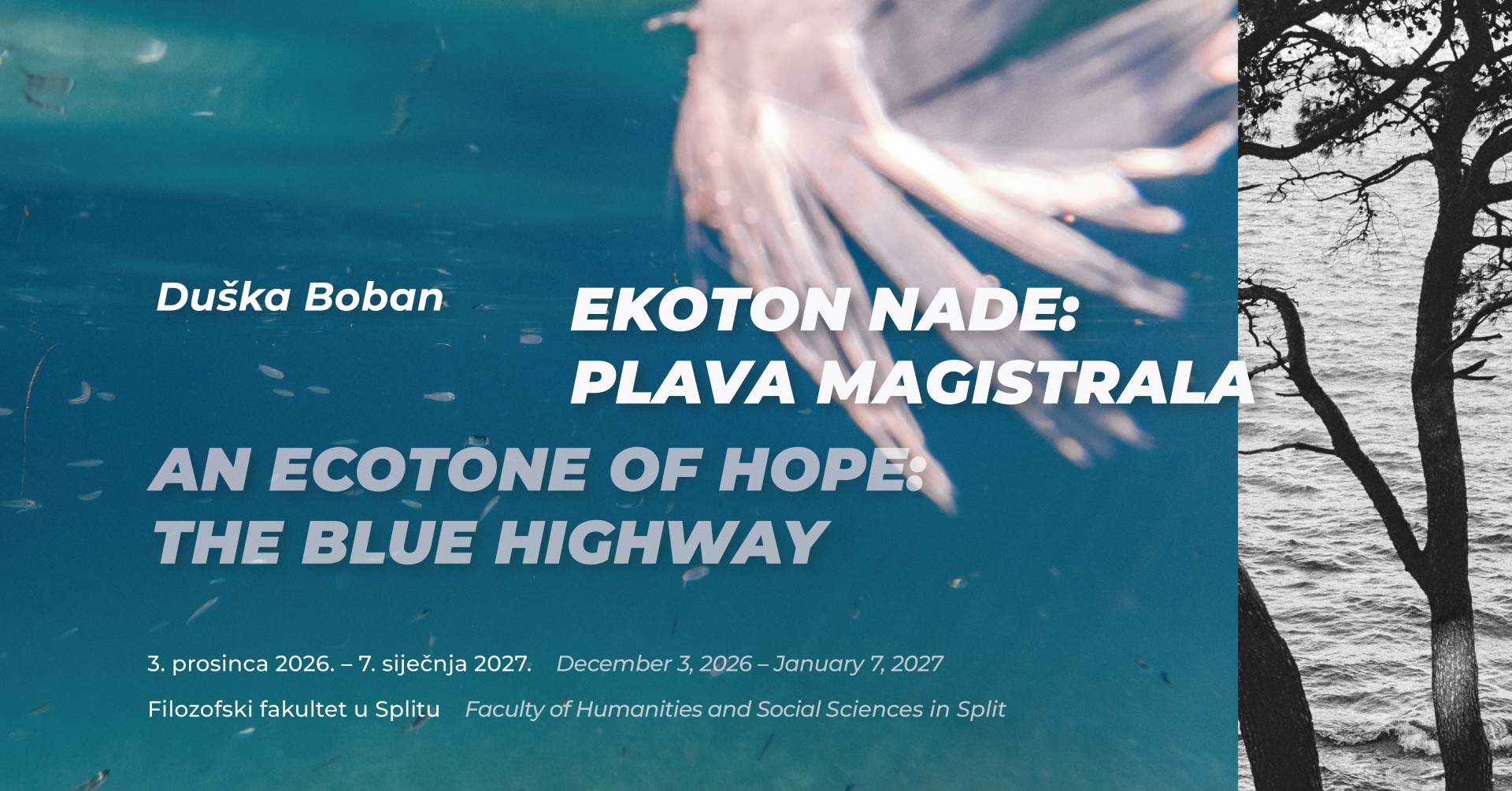
“An Ecoton of Hope: The Blue Highway”, art installation on the building of the Faculty of Humanities and Social Sciences in Split
December 3, 2026 – January 7, 2027
Opening of the installation:
3 December 2026 at 12:35, north façade of the Faculty of Humanities and Social Sciences in Split, Kroz Smrdečac Street
Conversation between the artist and the curator:
3 December 2026, 13:05–14:05, Aula Magna Marko Marulić (2nd floor), Faculty of Humanities and Social Sciences in Split, Poljička cesta 35
The spatial art installation by Duška Boban, realised as part of the REPER programme on the north façade of the building of the Faculty of Humanities and Social Sciences, University of Split, will be presented to the public on Thursday, 3 December 2026, at 12:35. On the same day, from 13:05 to 14:05, in the Aula Magna Marko Marulić on the second floor of the Faculty, a conversation between the artist and the programme curator, Dalibor Prančević, PhD, will take place as part of the two-day international interdisciplinary conference Sick City: Reprogramming Pathologies of Urban Spaces.
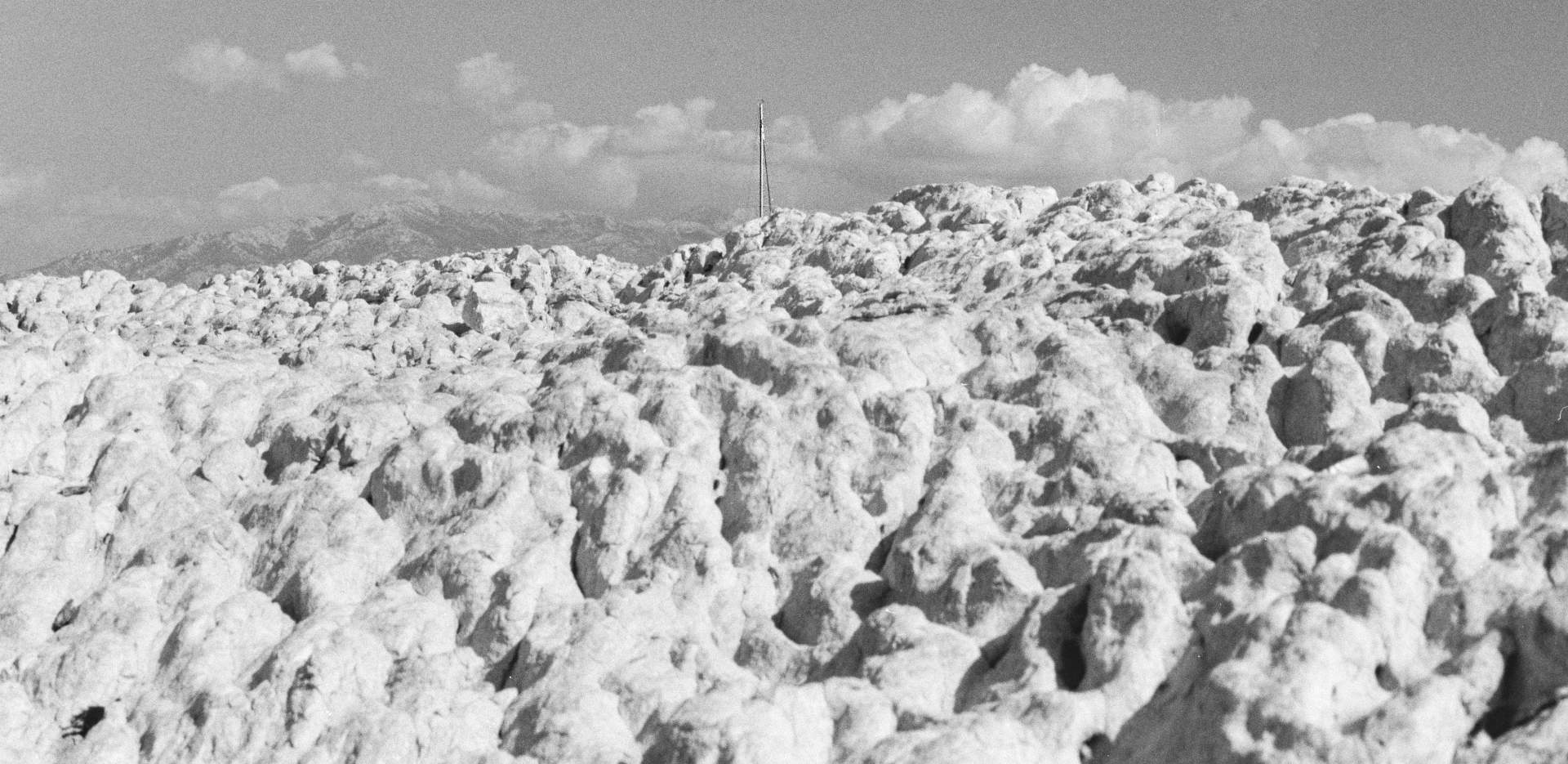
“Photography, meanwhile, as one Duška’s principal – and arguably privileged – media of artistic expression, takes on a multiplicity of functions. The artist’s photographic documentation, alongside statistical data taken from Vuko Bombardelli’s Blue Highway, creates a complex interplay between historical testimony and a contemporary perspective, inviting reflection on the critical fault lines of social reality (especially its contradictions, repressions and tensions
At the heart of the conceptual structure of Duška Boban’s site-specific intervention lies the notion of the ecotone, whose semantic complexity allows it to be transferred from its original disciplinary context of ecology into the broader field of cultural and social interpretation. Its etymology, derived from the Greek words oikos, meaning home or habitat, and tonos, denoting tension, suggests the concept’s intrinsic dynamics. In ecological terms, an ecotone is a transitional area between two different ecosystems, a space in which they come into contact and mutually interpenetrate. These areas may exhibit a high degree of biological diversity and intensive interaction, while also being characterised by competition, instability and various forms of pressure. Within artistic discourse, the ecotone becomes a fertile metaphor through which to interpret liminal situations. The boundary is thereby revealed as a dynamic space for contemplating the conditions that make survival and coexistence possible, but also as a place where the very durability of established demarcations is brought into question. It is against this interpretative backdrop that Duška Boban’s intervention unfolds on the north-facing reflective façade of the Faculty of Humanities and Social Sciences in Split, overlooking Kroz Smrdečac Street. Into the existing architectural and visual framework, the artist introduces photographic scenes captured along the northern side of Marjan Forest Park, in a zone where different natural and anthropogenic systems intersect. While the view seemingly extends in an uninterrupted spatial continuum, the conditions of life that take shape within it may be markedly different. These demarcations expose complex relations of interdependence, but also asymmetries, appropriation and vulnerability, bringing broader questions about the possibilities of sustainable coexistence into focus. Photography functions here as a sensitive medium for recording these relationships, at the same time transposing them into a new context in which ecological issues intersect with the historical experience of urban space. The strength of the artist’s approach lies in the aesthetic and poetic articulation of these relationships, through which the sensory immediacy of the image is transformed into a catalyst for critical discourse and reflection on social and historical tensions.”
from the foreword by Dalibor Prančević, PhD
Acknowledgements: Mea Bombardelli, Feđa Bombardelli, Ana Grgić, Sanja Matijević Barčot, Maja Urlić, Gorana Vežić, Gordan Jelavić, Alan Mance
The work has been realised as part of REPER, a multi-year project carried out in collaboration between the Faculty of Humanities and Social Sciences in Split and the Croatian Association of Visual Artists in Split. The project is conceived as a series of year-long artistic interventions aimed at encouraging critical reflection on selected artistic, cultural and social phenomena. Its originator and director is Associate Professor Dalibor Prančević, PhD. Through the REPER project, the building of the Faculty of Humanities and Social Sciences takes on a new function as an exhibition space and a platform for artistic research, critical dialogue and questioning the role of contemporary art in a broader social context.
The exhibited works were developed as part of a doctoral research project conducted at the Academy of Fine Arts and Design, University of Ljubljana.
The project has been supported by the Ministry of Culture and Media of the Republic of Croatia, the City of Split, the Kultura Nova Foundation and the Faculty of Humanities and Social Sciences in Split.